
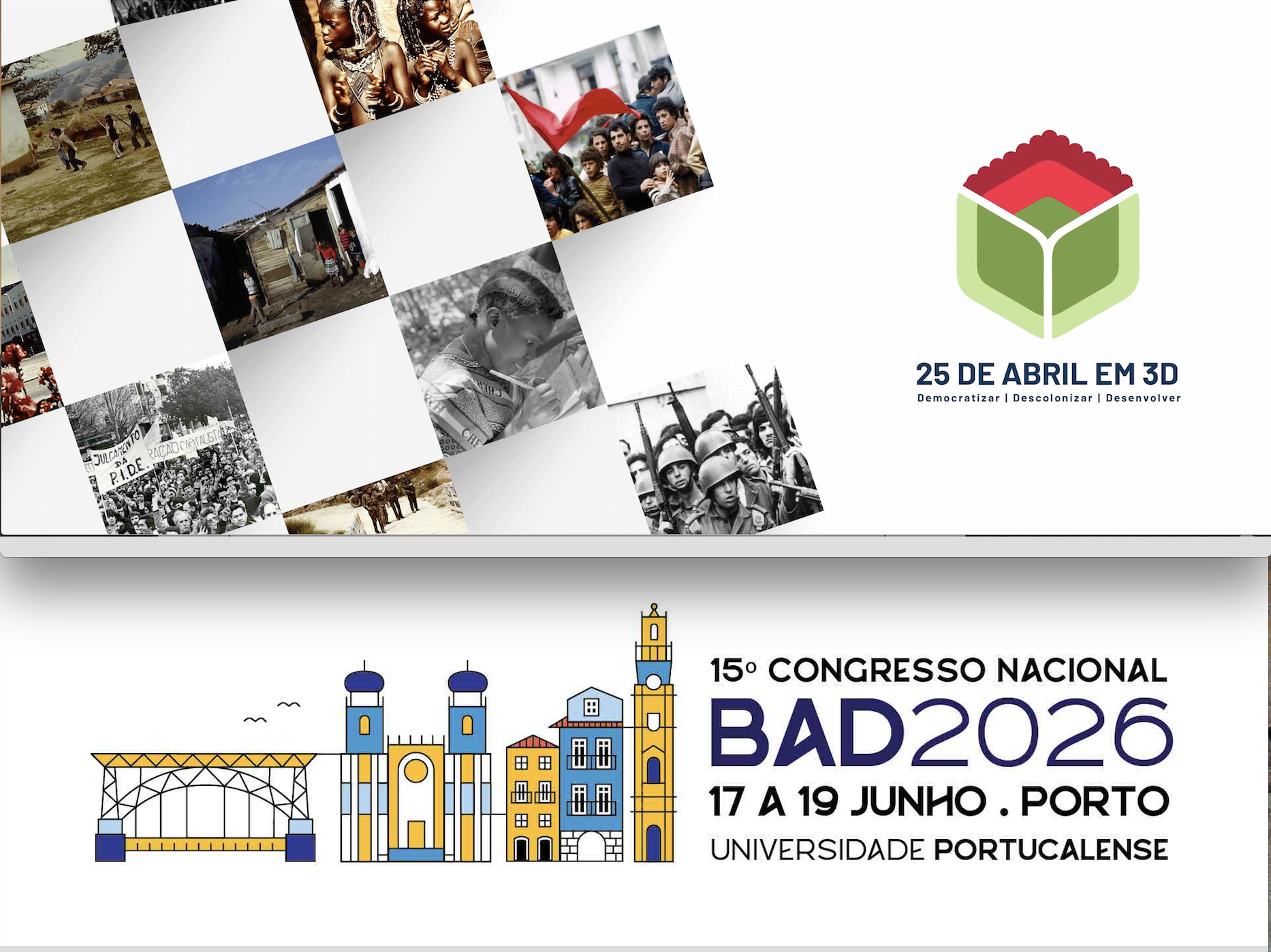
The project “25 April in 3D: Democratise, Decolonise, Develop” will be presented at the 15th National Congress of the BAD – Portuguese Association of Librarians, Archivists, Information and Documentation Professionals, which will take place from 17 to 19 June, at Universidade Portucalense in Porto, under the theme “Commitment to Democracy: Dialogue, Well-being, Inclusion”.
Participation in this national conference is fully in line with the project’s objectives, which seek to promote a critical, pluralistic and historically grounded understanding of the legacy of the 25 April 1974 Revolution. In a context marked by challenges to democracy, the spread of disinformation and the need to strengthen information literacy and civic participation, the initiative highlights the role of archives, documentation centres and educational resources in preserving memory and building an informed citizenry.
Approved under the call for proposals “25 April and Portuguese Democracy”, promoted by the Mission Structure for the Commemoration of the 50th Anniversary of the Revolution in conjunction with FCT, I.P., the project is funded by National Funds/State Budget (reference 2023.10730.25ABR), with funding of €24,925.74 and a duration of 18 months. The initiative is based on the enhancement of the documentary collection of the 25 April Documentation Centre at the University of Coimbra, mobilising historiographical, pedagogical and civic tools to bring different audiences closer to history and
and the debates surrounding the Portuguese revolutionary process.
Fifty years on from the April Revolution, issues such as the end of the colonial empire, the limits of participatory democracy, and the role of the state in the economy continue to shape public debate and underpin political and ideological divisions. The project organises its research and educational resources around the three fundamental pillars of the Armed Forces Movement’s programme — Decolonise, Democratise and Develop — seeking to highlight the diversity of perspectives that shaped the construction of Portuguese democracy.
Among the initiative’s main outcomes is the creation of a set of teaching resources aimed primarily at primary and secondary school pupils, particularly those in Years 9, 11 and 12. Developed in conjunction with the National Strategy for Citizenship Education and the Essential Learning Outcomes for the subject of History, these materials have also been validated by experts in the field.
The project also includes an educational kit comprising worksheets, activity suggestions, guided discussions, project work and guidelines for document analysis, designed for interdisciplinary use in different educational contexts.
Its main public manifestation is a travelling exhibition consisting of three thematic modules, each comprising five roll-up panels, which articulate
a historical context featuring reproductions of period documents. Designed to tour schools, libraries and local authorities, the exhibition is supported by the National Arts Plan and Rebobinar, helping to bring historical research closer to local areas and communities.
In addition, all the content produced is brought together in a digital repository, developed in collaboration with UC Framework, which makes audiovisual documents, audio testimonies and documentary sources available in full, free of charge. Through the integration of QR codes on the exhibition panels, visitors can access these resources directly, broadening the educational and civic reach of the project.
The presentation at the 15th BAD National Congress provides an opportunity to share this experience of documentary preservation, citizenship education and the democratisation of knowledge with the community of information professionals, reinforcing the contribution of archives and documentation centres to the preservation of democratic memory and the promotion of a more informed, inclusive and participatory society.